

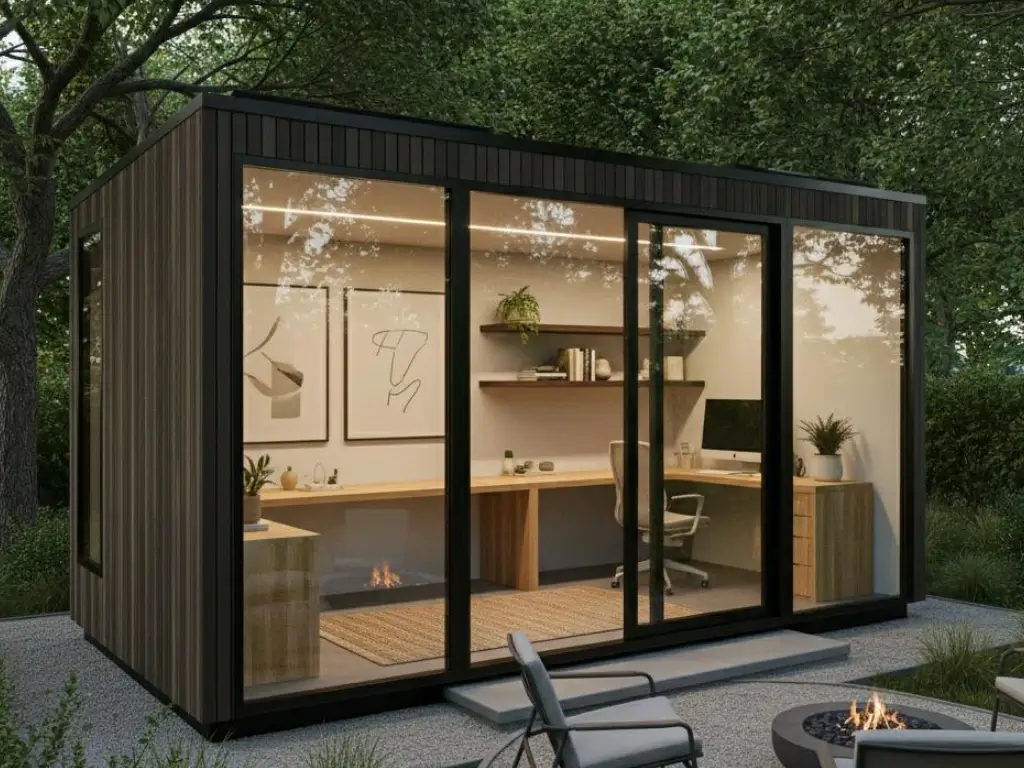
Remote work has created a new challenge for homeowners and developers: how to create a dedicated workspace without expensive renovations or sacrificing living space. Many people struggle with distractions, lack of privacy, and poor work-life separation. As hybrid work becomes permanent and property space becomes more limited, these issues directly impact productivity and long-term work efficiency. The solution lies in modular home office pod setups that create independent, insulated workspaces outside the main home environment.
A home office pod setup is a dedicated, standalone workspace built in an outdoor or semi-independent structure designed to provide privacy, insulation, and productivity-focused separation from the main home. The most effective setups use modular aluminum systems, insulated panels, and climate control integration to ensure year-round comfort and fast installation. This solution improves focus, reduces household distractions, and supports scalable residential or commercial deployment.
To fully understand how home office pods transform modern work environments, it is important to explore their structure, design logic, and real-world applications in both residential and B2B markets.
What Is A Home Office Pod Setup?

A home office pod setup refers to a purpose-built workspace located outside the main residential building, typically installed in gardens, courtyards, or adjacent outdoor areas. Unlike traditional home offices that rely on internal spare rooms, office pods create a physically separated environment designed specifically for productivity.
These pods are not simple sheds or temporary structures. They are engineered systems that combine insulation, lighting control, ventilation, and structural stability. In many modern applications, they are prefabricated and delivered as modular units, allowing rapid deployment with minimal construction disruption.
The goal is not just to provide extra space, but to redefine how work is experienced—by separating professional activity from domestic life in a controlled environment.
Why Home Office Pods Are Becoming Essential?

The rise of remote and hybrid work has permanently changed how space is valued inside residential properties. In dense urban environments, households often lack the luxury of spare rooms. Even when space exists, it is rarely optimized for productivity.
This creates three major problems:
- Continuous household interruptions during working hours
- Lack of psychological separation between work and personal life
- Inefficient use of living space for professional tasks
These challenges are no longer temporary. They directly affect long-term productivity, mental clarity, and work satisfaction.
As a result, homeowners, developers, and commercial operators are turning toward modular outdoor workspace solutions. Home office pods provide a practical way to create separation without structural renovation, making them a cost-efficient alternative to traditional construction.
Core Design Principles For A High-Performance Office Pod
A successful home office pod is built on several essential design principles that directly influence usability and performance.
Spatial Separation
A pod must create a clear boundary between home life and work life. Even short physical distance significantly improves concentration and reduces mental fatigue.
Acoustic Control
Noise reduction is critical. Whether it is household activity or external traffic, sound interference reduces cognitive performance. High-quality pods use sealed aluminum frames, insulated panels, and double glazing systems.
Thermal Efficiency
Without temperature control, outdoor pods become unusable in extreme climates. Proper insulation and ventilation ensure consistent internal conditions across seasons.
Lighting Optimization
Natural light improves productivity, but uncontrolled sunlight causes glare and overheating. Adjustable louvers and shaded glazing systems help balance visibility and comfort.
Structural Systems And Materials Used In Office Pods

Modern home office pods rely heavily on modular construction systems. These systems prioritize speed, durability, and scalability.
Common materials include:
- Aluminum framing for structural strength and corrosion resistance
- Insulated sandwich panels for thermal stability
- Tempered or double-glazed glass for visibility and sound control
- Powder-coated surfaces for weather protection
In advanced configurations, motorized pergolas, retractable roofing systems, and enclosed sunroom frameworks are used as the base structure. These systems allow flexibility in adjusting light exposure and airflow.
Manufacturers such as Ezysunroom specialize in these modular aluminum-based structures, making them suitable for fast deployment in both residential and commercial environments.
Cost Factors And ROI For B2B Buyers

The cost of a home office pod varies depending on materials, size, insulation level, and integrated systems such as HVAC and lighting.
Key cost drivers include:
- Structural complexity and material selection
- Level of insulation and glazing systems
- Electrical and connectivity integration
- Customization for branding or commercial use
From a B2B perspective, the return on investment is not only financial but operational. Developers and property owners benefit from:
- Increased property value
- Enhanced rental appeal
- Faster project deployment compared to traditional construction
- Scalable production models for multiple units
This makes modular office pods especially attractive for real estate developers, co-working operators, and hospitality providers.
How Modular Outdoor Structures Enable Faster Deployment?

One of the most important advantages of modern office pod systems is deployment speed. Traditional construction can take months, while modular systems significantly reduce installation time.
Companies like Ezysunroom specialize in factory-built systems that arrive pre-engineered and ready for assembly. This reduces on-site labor requirements and minimizes project delays.
For B2B buyers, this means:
- Predictable installation timelines
- Lower labor dependency
- Reduced construction risk
- Faster time-to-market for commercial projects
This shift toward prefabrication is redefining how outdoor workspace infrastructure is delivered globally.
Installation Process And Practical Considerations

A typical home office pod installation follows several key stages:
Site Preparation
The ground must be leveled and prepared to support structural loads. Drainage and accessibility are also evaluated at this stage.
Structural Assembly
Pre-fabricated aluminum frames and panels are assembled on-site. This stage is significantly faster than traditional construction.
Utility Integration
Electrical wiring, lighting systems, and optional HVAC units are installed. Connectivity for internet and smart systems is also configured.
Interior Setup
Workstations, furniture, and acoustic elements are added to complete the workspace environment.
Final Testing
The structure is tested for insulation performance, electrical safety, and environmental stability before use.
Future Trends In Home Office Pod Design

The future of home office pods is moving toward smarter, more adaptive systems. Several key trends are shaping this evolution:
- Integration of smart climate control systems
- Solar-powered energy independence
- Adaptive lighting systems based on user behavior
- Fully modular expansion capabilities
- Multi-purpose transformation between office, studio, and leisure space
As work environments continue to decentralize, office pods will increasingly function as standard infrastructure rather than optional additions.
Conclusion
Home office pod setups represent a structural shift in how workspaces are designed and delivered. They solve critical issues of space limitation, productivity loss, and work-life imbalance by creating dedicated, insulated environments outside the main home.
For B2B buyers, developers, and distributors, this is not just a design trend—it is a scalable infrastructure opportunity driven by long-term demand for flexible workspace solutions.
With factory-based systems and modular engineering, companies like Ezysunroom enable faster deployment, lower costs, and adaptable configurations for diverse project needs.
For inquiries, customization, or wholesale cooperation, contact:
admin@ezysunroom.com.au
As demand for flexible work environments continues to grow, now is the right time to explore modular home office pod solutions and integrate them into future-ready property development strategies.